
Posture & Headaches: The Research-Backed Connection | Chatswood Chiro
Posture & Headaches: What the Research Actually Shows.
Are poor posture and headaches related? Let’s dive deep into a factor I assess in almost every headache patient who walks into this clinic: posture, and see if there is a relationship.
It's easy to think of posture as a cosmetic issue — "stand up straight" advice from a parent. But the research tells a different story. The position of your head and neck has a measurable, well-documented relationship with headache — and understanding that relationship is often the key to actually resolving the problem, rather than just managing it.
The Posture-Headache Link - The Stats.
Researchers commonly measure posture using something called the craniovertebral angle (CVA) — essentially, how far forward the head sits relative to the shoulders and spine. A smaller angle means a more forward head position.
In one clinical study of patients with forward head posture, cervicogenic headache was present in 53.8% of cases — and a lower CVA (more forward head posture) was found to independently predict cervicogenic headache, alongside poor sleep quality. A separate cross-sectional study of university students found a strong positive correlation between forward head posture and cervicogenic headache, alongside neck pain and nerve-related symptoms.
The pattern shows up in migraine too. Research comparing people with migraine to headache-free controls found significantly greater forward head posture and increased thoracic kyphosis (upper back rounding) in the migraine group — with the two closely correlated to one another. It's worth noting the research isn't unanimous — one smaller study of chronic tension-type headache found posture didn't correlate as strongly with headache severity, even though a treatment program still improved outcomes. This tells us posture is rarely the only factor, but for a large proportion of patients, it is a significant and correctable one.
Why Your Head Position Matters So Much
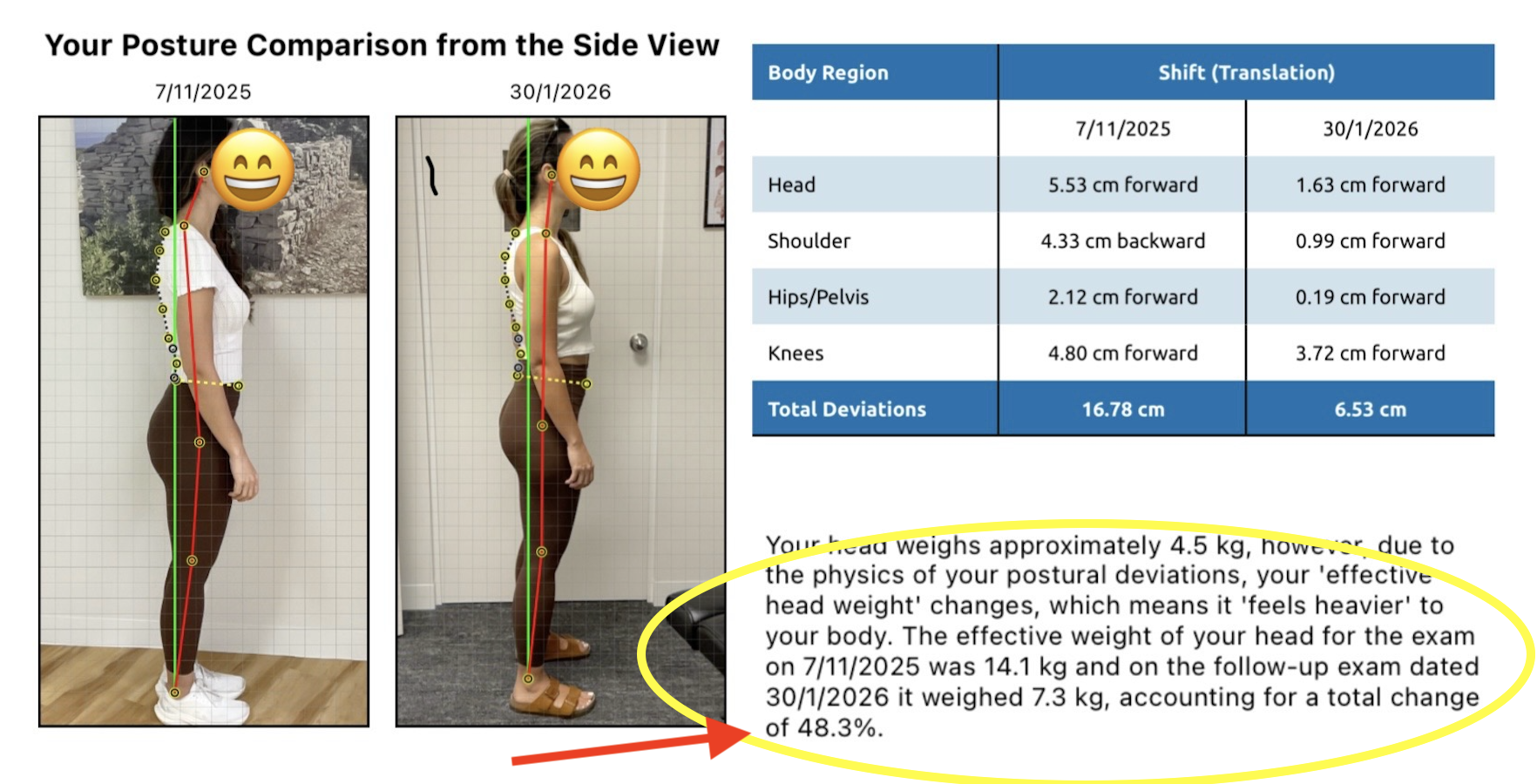
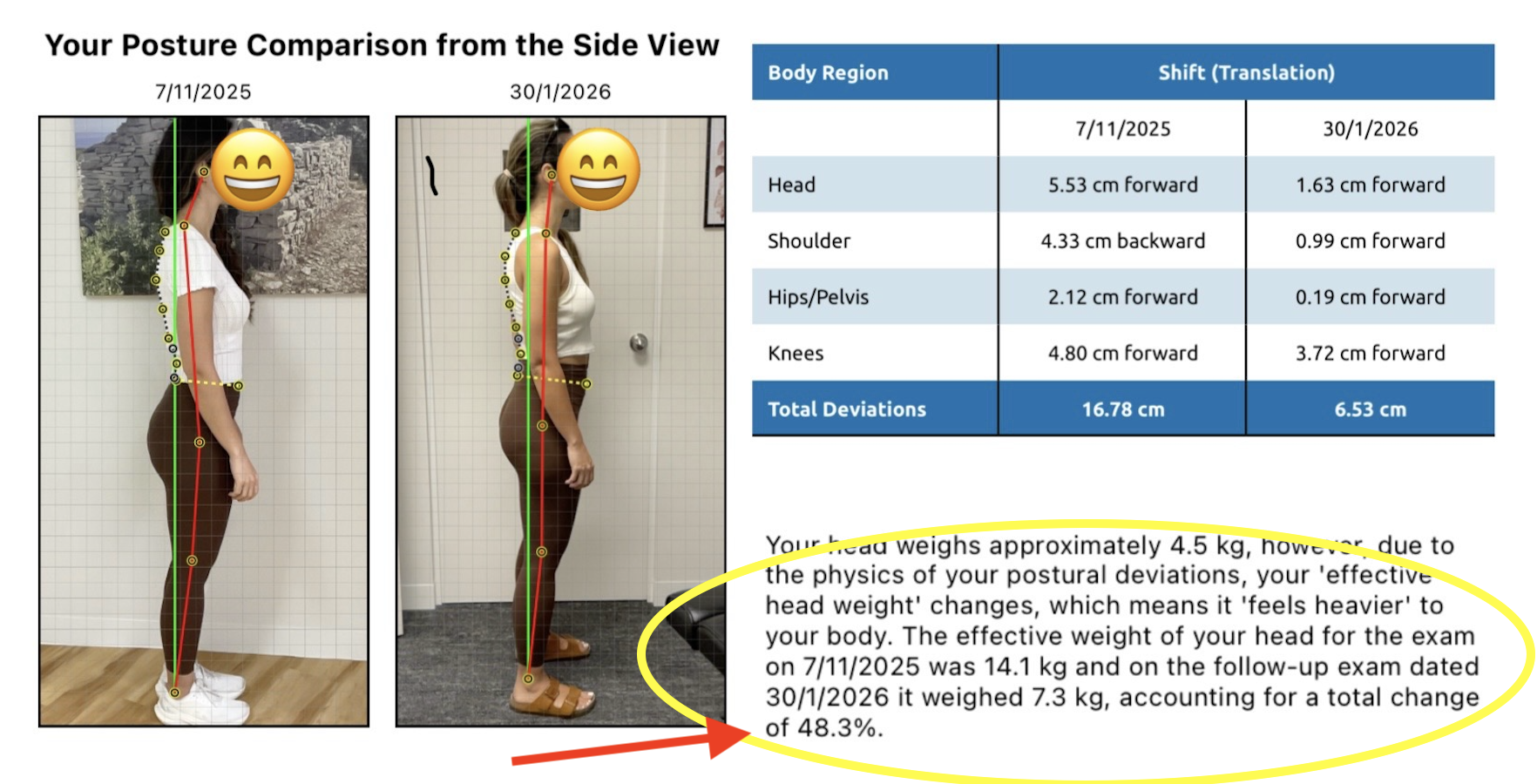
Your head weighs roughly 4.5–5.5kg — about the weight of a bowling ball. When it sits directly over your shoulders, your neck's supporting muscles and ligaments carry that load efficiently. But for every few centimetres your head shifts forward — the posture created by hours of looking down at a phone or laptop — the effective load on your neck increases substantially, because of the leverage involved.
That extra load has to go somewhere. It typically shows up as:
Sustained tension through the upper trapezius and suboccipital muscles (at the base of the skull) — a well-recognised trigger for tension-type headache
Increased mechanical stress on the small joints of the upper cervical spine — a key contributor to cervicogenic headache
A gradual loss of the neck's natural forward curve (cervical lordosis), which changes how load is distributed through the spine over time
This is the mechanical chain we're looking at: posture load → muscular and joint stress → headache. Treating only the headache with medication doesn't address any part of that chain — which is one reason headaches so often return.
Chiropractic Care: Addressing the Cause, Not Just the Symptom
This is the core distinction I want to draw for you. A great deal of headache management — understandably — focuses on the symptom: the pain itself. Chiropractic care, done properly, focuses further upstream: on the postural and mechanical dysfunction that may be producing the pain in the first place.
A 2021 pilot randomised controlled trial investigated exactly this idea in patients with chronic cervicogenic headache and confirmed forward head posture. Patients received a multimodal care program, with one group also receiving a cervical extension traction device (the Denneroll) aimed specifically at restoring the neck's normal curve and head position. At 2-year follow-up, the group who received the additional postural correction showed improvements in forward head posture, cervical lordosis, headache frequency and headache-related disability.
This reflects the broader logic supported by the 2026 chiropractic clinical practice guideline discussed in last week's article: spinal assessment and care — inclusive of addressing postural and joint dysfunction — is a recommended part of managing cervicogenic and tension-type headache.
In plain terms: if your headache is being driven, even partly, by the position and mechanics of your neck, correcting that position is a legitimate and researched avenue — not just masking the pain until it returns.
What This Looks Like in Practice
When posture is identified as a contributing factor, care typically involves three parts working together:
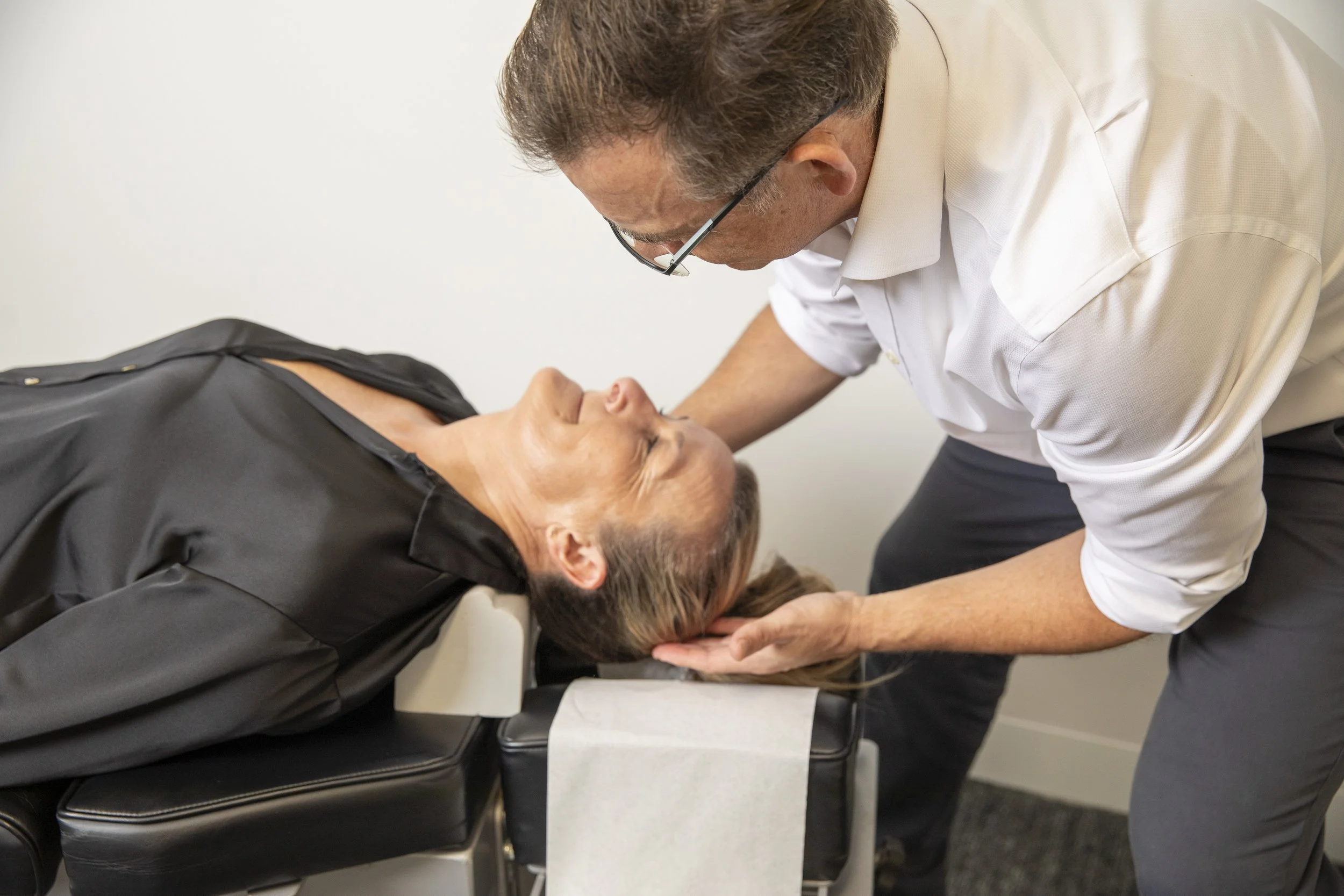
Chiropractic adjustment — restoring normal joint motion in the areas of the spine carrying the excess load
Postural correction tools — including the Denneroll cervical orthotic, used to help restore the neck's natural curve between visits (see below)
Daily habit change — because no amount of in-clinic correction will hold if the same postural load is recreated for eight hours a day at a desk
Daily Habits Worth Changing
Screen height — bring the screen to eye level rather than tilting your head down to meet it
Break frequency — every 30 minutes, come out of a forward-head position, even briefly
Phone use — hold your phone up rather than looking down into your lap; this alone significantly reduces neck flexion load
Sleep setup — a pillow that's too high or too low undoes hours of daytime postural correction overnight
Bag and desk setup — uneven loading (single-shoulder bags, monitors off to one side) can compound postural asymmetry over time
Corrective Exercise: YWTL and the Denneroll
Two specific tools I use regularly in this practice, backed by research on posture correction, are:
YWTL exercises — a scapular stabilisation sequence (named for the arm positions that trace each letter) that strengthens the lower trapezius and scapular retractors while stretching the tight chest and shoulder muscles that pull posture forward. Research on scapular stabilisation exercise programs has shown measurable improvement in forward head posture and associated muscle activity patterns in as little as four weeks. These exercises directly target the muscular imbalance — weak scapular retractors, tight anterior chest — that keeps posture pulled forward.
Denneroll cervical orthotic — an at-home traction device used to help restore the cervical spine's natural forward curve. As referenced above, the 2-year pilot trial specifically measuring this device in cervicogenic headache patients found meaningful improvements in posture, cervical curve, headache frequency and disability. I prescribe this only where it's clinically appropriate, with specific instructions on positioning and duration.
Neither of these replaces chiropractic adjustment — they're designed to extend and support the changes made in clinic, between visits.
Where to From Here
If your headaches have a pattern — worse by the end of a workday, worse after long stretches on a screen, accompanied by a stiff or aching neck — posture is well worth investigating properly. I offer a complimentary initial consultation to assess your posture, cervical spine and headache pattern together, and to talk you through whether a corrective approach is appropriate for you.
👉 Book your complimentary posture & headache assessment today.
FAQ
Q: Can bad posture really cause a headache, or is it just correlation? A: The current research shows a strong association between forward head posture and both cervicogenic headache and migraine-related disability, and a controlled trial specifically correcting posture in cervicogenic headache patients found improvements in headache frequency and disability. This supports posture as a genuine contributing factor for many patients — though as with any headache, individual assessment is needed to confirm the specific driver in your case.
Q: What is the Denneroll and is it safe to use at home? A: The Denneroll is a cervical traction orthotic designed to help restore the neck's natural forward curve. It's intended for at-home use, but positioning and duration should be set by your chiropractor based on your specific cervical spine assessment and, where relevant, imaging.
Q: How long does it take to correct forward head posture? A: This varies by individual, and depends on how long the postural pattern has been present and how consistently corrective exercises and habit changes are followed. Clinical trials assessing postural correction devices have followed patients over periods of 10 weeks to 2 years to observe meaningful, lasting change — this is a gradual process, not an overnight fix.
Q: What are YWTL exercises and do I need equipment? A: YWTL exercises are a bodyweight scapular stabilisation sequence that can be done at home with no equipment, targeting the muscles that pull the shoulders and head back into a more neutral position. I'll demonstrate correct technique at your consultation.
People Also Ask
Does looking down at your phone cause headaches? Sustained forward head posture from phone use increases mechanical load through the neck's joints and muscles, which is a recognised contributing factor to tension-type and cervicogenic headache in many people.
What is cervicogenic headache? A headache originating from the joints, muscles or nerves of the upper neck, often felt on one side and linked to postural and mechanical dysfunction in the cervical spine.
Can exercise fix posture-related headaches? Targeted exercise — particularly scapular stabilisation work such as YWTL exercises — has been shown to improve forward head posture and associated muscle activity, and may help as part of a broader care plan alongside chiropractic treatment.
What is a normal head posture? Ideally, the head sits directly above the shoulders rather than jutting forward. This is measured clinically using the craniovertebral angle, assessed via postural photography or X-ray.
References
Cross-sectional study, Cervicogenic headache in forward head posture: frequency and associated factors. 2025.
Association of forward head posture with neck pain, cervicogenic headache, neuropathy, and neck mobility among university students. Foundation University Journal of Rehabilitation Sciences, 2023.
Evaluation of forward head posture and thoracic kyphosis in migraine. ScienceDirect, 2023.
Moustafa IM, et al. Does restoration of sagittal cervical alignment improve cervicogenic headache pain and disability: A 2-year pilot randomized controlled trial. 2021.
Trager RJ, Daniels CJ, Hawk C, et al. Chiropractic Management of Adults with Cervicogenic or Tension-Type Headaches: Development of a Clinical Practice Guideline. 2026.
Effect of scapular stabilization exercise on neck alignment and muscle activity in patients with forward head posture. Journal of Physical Therapy Science, PMC.
Effects of Scapular Stabilization Exercise in Young Adults with Forward Head Posture. Journal of Experimental Biology and Agricultural Sciences.
Treleaven J, et al. Neck mobility and forward head posture are not related to headache parameters in chronic tension-type headache. 2007.
General information only — not a substitute for individual clinical assessment. Always consult your healthcare provider about your specific symptoms.