
Poor Posture & Health | Chiropractor Chatswood
What if the way you carry yourself could tell us something about how well your body is ageing?
I'm not talking about standing taller for a photo. I'm talking about your ability to breathe, move, keep your balance and stay active as you get older.
The short answer: research shows that older adults with an excessively rounded upper back, known as hyperkyphosis, have higher mortality rates, poorer lung function and lower physical performance than those without it. Hyperkyphosis appears to be a marker of declining health rather than a proven cause of it. The encouraging part is that spinal mobility, strength and physical function are things we can work on at any age.
Key takeaways
In a study of 1,353 older adults, people with hyperkyphosis had about a 44% higher mortality rate over the follow-up period.
A more rounded upper back is associated with reduced lung function and poorer physical performance.
Posture is a marker of health, not a guarantee of how long anyone will live.
Targeted strengthening and posture exercise has been shown to modestly reduce kyphosis in older adults.
Height loss, a worsening curve, persistent pain or unexplained breathlessness deserve professional assessment.
What is hyperkyphosis?
Hyperkyphosis is an excessive forward curve of the upper back (thoracic spine). It often shows up as rounded shoulders, a hunched upper back and the head sitting forward of the body.
A healthy thoracic spine has a gentle natural curve. When that curve becomes exaggerated, it's called hyperkyphosis. It's estimated to affect roughly 20–40% of older adults, and it becomes more common as we age.
Is there a link between posture and how long you live?
Yes. Research has found that an excessively rounded upper back is associated with higher mortality in older adults.
The 2004 study. Dr Deborah Kado and colleagues followed 1,353 older men and women and published their findings in the Journal of the American Geriatrics Society. People with hyperkyphotic posture had approximately a 1.44 times higher adjusted rate of death during the follow-up period.
The 2009 study. A follow-up study by the same research group, published in Annals of Internal Medicine, found that greater upper-back curvature was linked to higher mortality in older women. The link held even after accounting for osteoporotic spinal fractures.
What this does and doesn't mean. These studies did not prove that poor posture causes people to die earlier. Researchers believe a rounded upper back may reflect other things going on in the body, such as:
reduced muscle strength
bone health changes
declining physical function
general health status
That makes posture a useful warning sign worth paying attention to.
Can a rounded upper back affect your breathing?
It can. Research has associated greater thoracic kyphosis with reduced lung function in older adults.
You breathe around 20,000 times a day. Every breath depends on your chest wall moving freely:
Your diaphragm contracts.
Your rib cage expands.
Your lungs fill with air.
Your thoracic spine forms the back of that rib cage. When the upper back becomes increasingly rounded and stiff, it may limit how freely the ribs expand, and breathing can become less efficient. This is especially true when the spinal changes are pronounced.
Not everyone with rounded shoulders has reduced lung capacity, and posture is only one of many factors that affect breathing. But it's a good reminder that your spine does far more than hold you upright.
Does posture affect your heart?
There is an indirect connection between poor posture and the heart. Let’s join the dots…
If breathing becomes more restricted, or movement becomes harder and less comfortable, people tend to do less physical activity. Over time, less activity can mean poorer cardiovascular fitness.
So posture, breathing, muscle strength, activity levels and heart health are interconnected parts of healthy ageing. That's why keeping your spine mobile and your body strong matters.
Why does posture get worse as we age?
Several factors can change the shape of the spine over time:
Daily habits: long hours sitting, looking down at phones (see our post on [tech neck]), and driving
Muscle loss: strength declines with age if we don't actively maintain it
Spinal changes: wear in joints and intervertebral discs
Bone health: osteoporosis and vertebral compression fractures can increase the thoracic curve
Stiffness: reduced spinal mobility, particularly in the upper back
It's rarely as simple as telling someone to "stand up straight." Understanding why your posture has changed is the first step.
In today’s tech age, with an increase of devices, I am seeing an increase in the thoracic kyphosis and an decrease in the cervical lordosis and a younger and younger age.
My concern?
That the daily habits set up from a child and a teen will lead to an increase of this aging effect.
Can posture be improved, even later in life?
For many people, yes, to a degree. In the SHEAF randomised controlled trial (Osteoporosis International, 2017), older adults with hyperkyphosis did a targeted spine-strengthening and posture-training program. They achieved a modest reduction in their kyphosis angle.
Exercise that builds back strength, balance and mobility is one of the best-supported tools we have for healthy ageing.
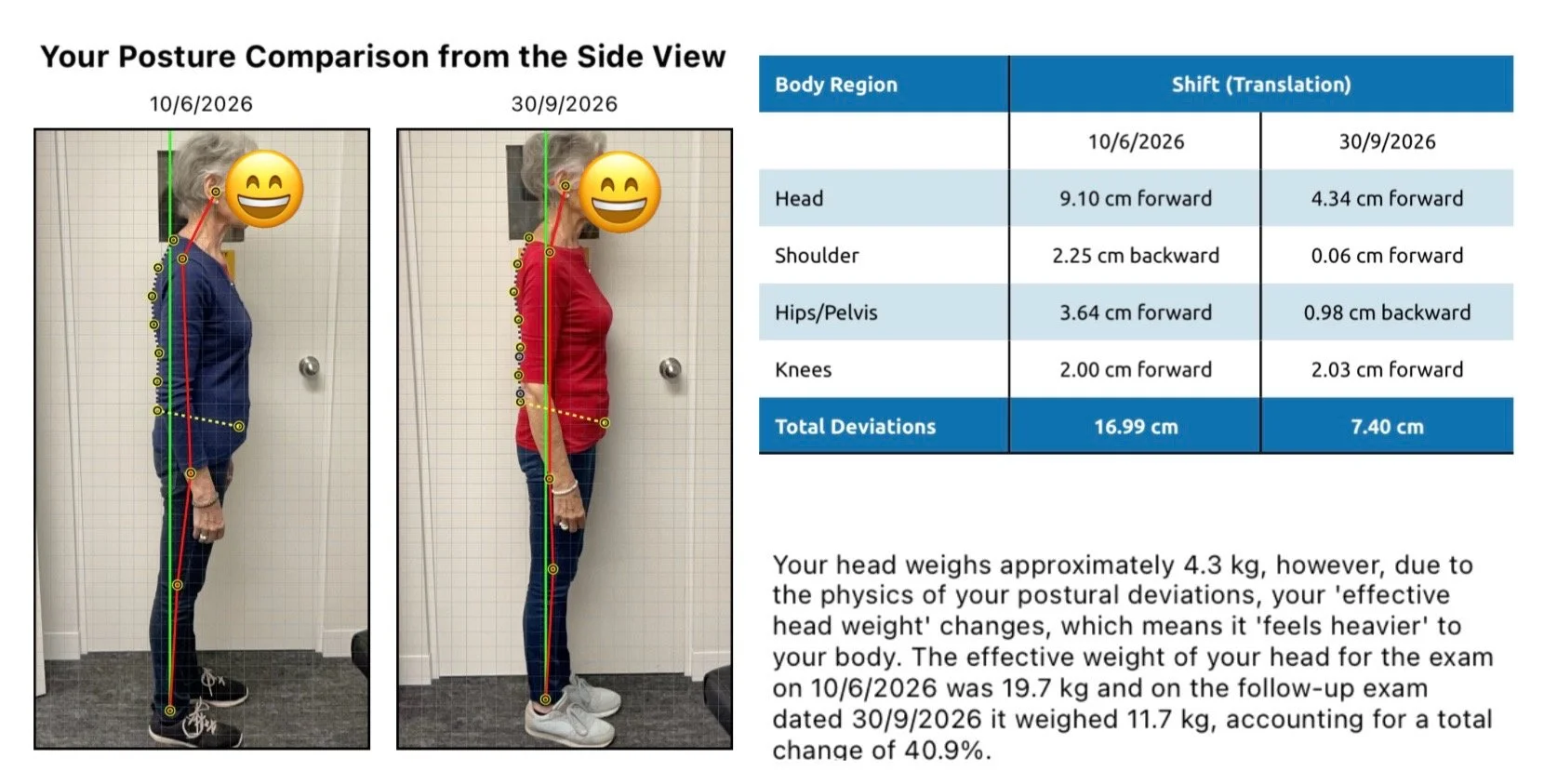
From a clinical perspective, we have seen hundreds of patient’s posture improve with the specific care that we give. A combination of chiropractic adjustments, the changing of poor habits and simple effective movement and exercise has helped to add years to life and life to years.
How can a chiropractor help with posture?
A chiropractor can assess how your spine is moving and functioning, identify what may be contributing to postural changes, and recommend care and exercises tailored to your examination findings.
At Family Chiropractic Chatswood, a thorough assessment goes well beyond checking whether your shoulders are level. We look at:
whether your thoracic spine is moving comfortably
areas of restricted joint movement
muscle weakness or stiffness affecting how you carry yourself
structural changes that may need further investigation
how these findings affect your everyday activities
Depending on your needs, this may include digital postural analysis, neurological and orthopaedic testing, spinal movement assessment, and on-site digital X-rays when clinically indicated.
Chiropractic adjustments. I primarily use Activator Methods®, a low-force chiropractic technique I've taught nationally since 2003, alongside other approaches where appropriate. Adjustments can help musculoskeletal complaints and movement restrictions. Improving spinal movement, however, is not the same as permanently correcting a structural curve.
Rehabilitation and strength. We may also recommend home exercises to improve mobility, strengthen the muscles that support your spine, and build better movement habits. For selected patients, this can include posture rehabilitation tools such as Denneroll® devices. These need individual assessment, and evidence for lasting structural correction from specific devices remains limited.
Our approach is built on three pillars, which I describe in practice: Alignment, Activation and Awareness. Care, movement and habit change work together, rather than relying on any single treatment.
What about breathing and heart health? If stiffness or weakness is limiting how you move, addressing it may help you exercise more comfortably. Posture-focused rehabilitation has also improved some measures of respiratory function in selected groups. But we can't claim that a chiropractic adjustment will increase lung capacity, improve heart performance or extend lifespan. Those outcomes require their own evidence.
Concerned about your posture? Book a complimentary initial consultation at Family Chiropractic Chatswood. If chiropractic isn't right for you, we'll tell you, at no charge. Call (02) 9415 4606.
It's not just about living longer. It's about living better.
After more than 30 years in practice, one thing that continues to interest me is how differently people age. Some stay active, mobile and independent well into their later years. Others find everyday tasks becoming harder.
There are many reasons for that. But strength, spinal movement, balance, bone health and regular activity give us practical things to work on throughout life.
We can't stop ageing, and no single treatment can guarantee better health or a longer life. We can take an active interest in how our bodies work.
A quick posture self-check
Ask yourself:
Has my head gradually moved forward?
Have my shoulders become more rounded?
Is standing comfortably upright harder than it was ten years ago?
Have I noticed changes in my movement or flexibility?
Have I lost height?
If you answered yes to any of these, don't dismiss it as "just getting older." Significant changes in spinal curvature, height loss, persistent pain or unexplained breathlessness deserve appropriate professional assessment. Breathlessness in particular should be checked by your GP.
Frequently asked questions
Does bad posture shorten your life? Research shows older adults with hyperkyphosis have higher mortality rates, but it hasn't been proven that posture itself causes earlier death. A rounded upper back is best seen as a marker of other health changes worth investigating.
Can a hunched back affect breathing? Greater thoracic curvature is associated with reduced lung function in older adults, likely because a stiff, rounded upper back can limit rib cage expansion. Not everyone with rounded shoulders is affected.
Can you fix a hunched back in older age? Targeted strengthening and posture-training exercise has been shown to modestly reduce kyphosis in older adults. How much change is possible depends on the cause. Curves caused by vertebral fractures behave differently from those caused by stiffness or weakness.
Can a chiropractor fix posture? A chiropractor can assess spinal function and may help with movement restrictions and related musculoskeletal complaints, combined with exercises and habit change. Chiropractic care, as good as it is, should not be expected to permanently correct a structural spinal curve on its own.
When should I see someone about my posture? See a health professional if you notice stooping, rounded shoulders, in ladies a hump on the base of your neck, height loss, a curve that's getting worse, persistent back pain, or difficulty taking in a deep refreshing breath.
About the author
Dr Brett Grant is the principal chiropractor at Family Chiropractic Chatswood on Sydney's North Shore, which he established in 1996. He has more than 30 years of clinical experience. He has been a national Activator Methods instructor since 2003, has served on the Board of the Australian Spinal Research Foundation, and currently on the board of the NSW Chiropractic Student’s Trust Fund